
Google Ads vs Meta Ads: Which Platform Is Better for Business Growth?
Introduction
Digital marketing is evolving faster than ever, and brands that fail to adapt risk falling behind in a highly competitive market. By 2027, technologies like Artificial Intelligence, automation, personalized advertising, and immersive content will completely reshape how businesses connect with customers. Modern consumers expect faster communication, engaging experiences, and content tailored to their interests.
To stay relevant and grow successfully, brands must understand upcoming digital marketing trends and implement smarter strategies. From AI-powered campaigns to short-form video content, the future of marketing is all about innovation, creativity, and customer experience.
Differences Between Google Ads and Meta Ads
1. User Intent
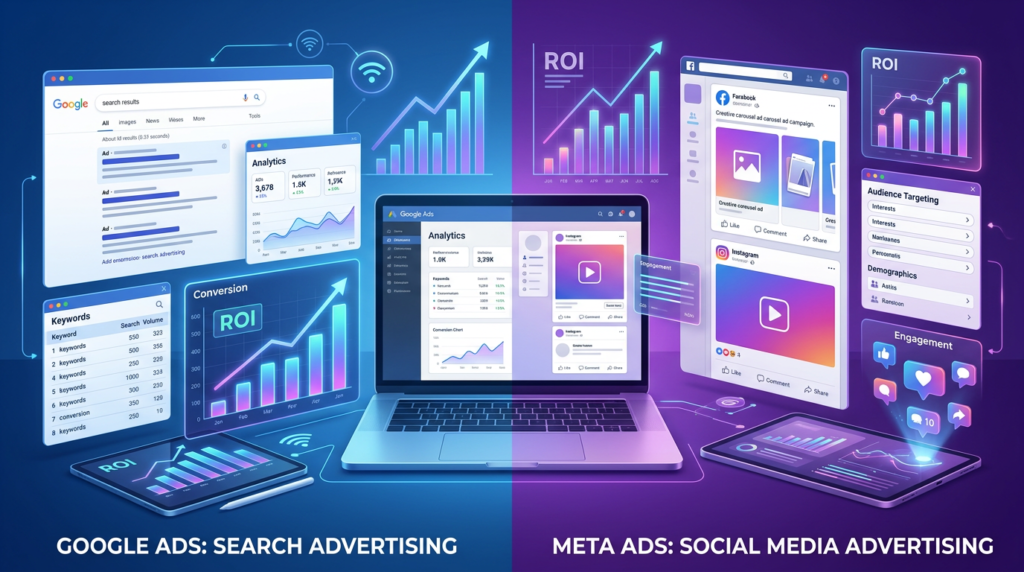
Google Ads targets users actively searching for products or services, while Meta Ads targets users based on interests and online behavior.
2. Platform Type
Google Ads appears on search engines, websites, and YouTube. Meta Ads mainly appears on Facebook, Instagram, and Messenger.
3. Advertising Goal
Google Ads is ideal for lead generation and sales conversions. Meta Ads is better for brand awareness and audience engagement.
4. Audience Targeting
Google Ads focuses on keyword-based targeting, while Meta Ads uses demographic, interest, and behavioral targeting.
5. Ad Formats
Google Ads offers search, display, shopping, and video ads. Meta Ads provides image ads, reels, stories, carousel ads, and feed ads.
6. Customer Journey
Google Ads reaches users with high buying intent, while Meta Ads helps attract and nurture potential customers.
7. Cost and ROI
Google Ads may have higher CPC but often delivers stronger conversion intent. Meta Ads can be more affordable for reach and engagement campaigns.
8. Best Use Case
Google Ads works well for businesses seeking immediate conversions, while Meta Ads is effective for building brand visibility and community engagement.
Benefits of Google Ads for Businesses
Google Ads helps businesses reach potential customers at the exact moment they are searching for products or services online. It increases brand visibility on search engines, drives targeted website traffic, and improves lead generation.
One of the biggest advantages of Google Ads is its advanced targeting options, allowing businesses to reach audiences based on keywords, location, device, and user behavior. It also provides measurable results, helping marketers track clicks, conversions, and return on investment (ROI).
Google Ads supports businesses of all sizes by offering flexible budgets, faster online visibility, and AI-powered campaign optimization. With the right strategy, businesses can increase sales, improve customer reach, and grow more effectively in the competitive digital market.
Google Ads vs Meta Ads Cost Comparison
Google Ads and Meta Ads both offer flexible advertising budgets, but their costs and performance can vary depending on campaign goals and audience targeting. Google Ads often has a higher cost-per-click (CPC) because it targets users with strong purchase intent through search results. However, it can deliver better conversion rates and higher return on investment for businesses focused on sales and lead generation.
Meta Ads, on the other hand, is usually more affordable for reach, engagement, and brand awareness campaigns. Businesses can reach large audiences on platforms like Facebook and Instagram at a lower cost compared to search advertising. Meta Ads performs especially well for visual storytelling, social engagement, and audience building.
Choosing between the two platforms depends on business objectives, budget, and marketing strategy. Many brands combine both Google Ads and Meta Ads to achieve balanced growth, visibility, and conversions.
Final Thoughts
Both Google Ads and Meta Ads are powerful platforms that can help businesses grow successfully in the digital market. Google Ads is highly effective for reaching customers with strong buying intent, while Meta Ads excels at building brand awareness and audience engagement.
Instead of choosing only one platform, many successful businesses combine both strategies to maximize results. The best advertising approach depends on business goals, audience behavior, and marketing objectives. Brands that use these platforms strategically can improve visibility, increase conversions, and achieve long-term digital growth.
Thank you, I have recently been searching for information about this topic for a long time and yours is the best I have found out so far.
However, what concerning the bottom line? Are you positive
about the supply?
Yes
Woah! I’m really digging the template/theme of this blog.
It’s simple, yet effective. A lot of times it’s challenging
to get that “perfect balance” between superb usability
and visual appearance. I must say that you’ve done a very good job with this.
Additionally, the blog loads super fast for me on Opera.
Outstanding Blog!
I have read so many articles or reviews
regarding the blogger lovers however this paragraph is truly a nice piece of writing,
keep it up.
Thank you
Solid read! As someone interested in managing money better, I really value content like this.
It’s refreshing to see down-to-earth advice instead of empty hype.
Thank you